
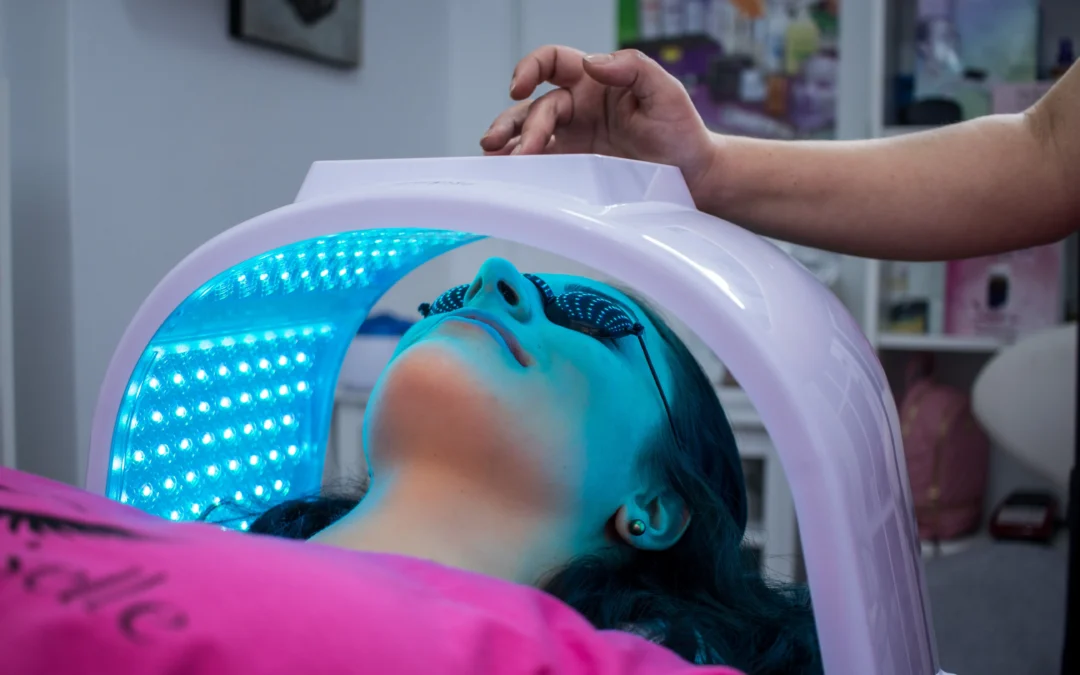
LED light therapy often enters the picture when someone is already doing so much to care for a body that feels tender, closely watched, and under pressure. That might look like trying to conceive while tracking every cycle detail, moving through IVF with equal parts hope and fatigue, or recovering postpartum while wanting gentle support that doesn’t feel aggressive or overwhelming.
For many women, the appeal of LED light therapy is simple. It’s non-invasive, quiet, and grounded in a real physiological idea: certain wavelengths of light can interact with tissue in ways that support repair and recovery. That doesn’t make it a cure-all, and it shouldn’t replace medical care. But it can fit thoughtfully into a broader plan for women’s wellness.
In a fertility or pregnancy setting, that broader plan matters. Reproductive health rarely lives in a single body part. Sleep, stress, circulation, inflammation, tissue healing, and nervous system regulation all affect how someone feels day to day. That whole-body view is also why this therapy often catches the attention of people who are already interested in acupuncture and Traditional Chinese Medicine.
Your Introduction to LED Light Therapy
LED light therapy is a form of photobiomodulation, which means light is used to influence biological activity in tissue. In plain language, the goal is to provide cells with a usable light signal that supports normal repair processes. For someone trying to conceive, managing pregnancy discomfort, or healing after birth, that gentle approach can feel far more approachable than a treatment that’s harsh or invasive.
This therapy usually uses visible red light or near-infrared light rather than ultraviolet light. That distinction matters because people sometimes confuse all light-based treatments with tanning or heat-based devices. LED therapy is different. It’s designed to support tissue, not damage it.
Why does this matter in reproductive wellness
Women seeking fertility or pregnancy support often aren’t looking for one dramatic intervention. They’re looking for steady, safe ways to care for the body while also working with an OB-GYN, a reproductive endocrinologist, a midwife, or another medical provider. A complementary option can make sense in that setting when it’s used responsibly.
A whole-body perspective also helps reduce confusion. Someone may ask about LED therapy for one specific concern, such as skin healing or postpartum hair changes. Still, the deeper question is often whether the body is getting enough support overall.
Complementary care works best when it supports the body’s own healing capacity and stays in coordination with medical treatment, not in competition with it.
Why patients often connect it with acupuncture
Traditional Chinese Medicine uses a systems view. Instead of separating symptoms into unrelated boxes, it looks at patterns such as depletion, stagnation, stress, and recovery. LED light therapy comes from a different tradition, but many patients notice a shared philosophy. Both approaches are often used to support balance, circulation, repair, and resilience.
That overlap doesn’t mean they’re identical. It means they can sit beside each other in a thoughtful care plan.
What Is LED Light Therapy and How Does It Work
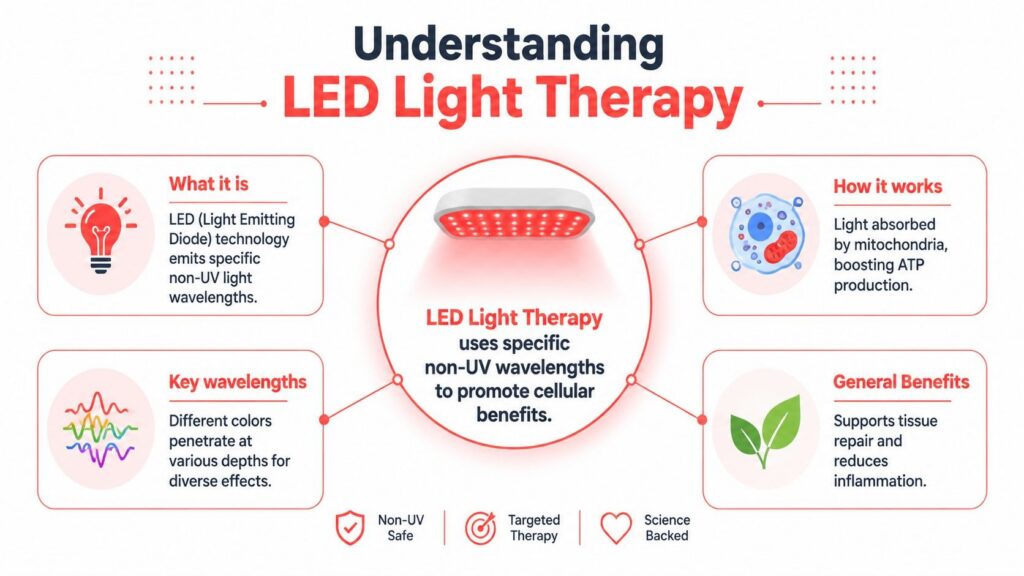
If you are trying to support fertility, regulate stress, or recover well after pregnancy, it helps to know what a therapy is doing in the body. LED light therapy can sound technical at first, but the basic idea is straightforward. It uses specific non-UV wavelengths of light to interact with tissue in a controlled way.
A simple way to understand what the light is doing
A useful comparison is sunlight on a plant leaf, but on a much smaller and more specific scale. Human cells do not make food from light. Instead, certain wavelengths appear to influence how cells carry out repair and energy-related processes.
This is one reason photobiomodulation is often discussed alongside mitochondrial function. Mitochondria help produce cellular energy, so that you can picture them as tiny energy stations inside the cell. The goal is not to force the body to do something unnatural. The goal is to support normal cellular function, especially in tissues experiencing inflammation, strain, or recovery.
For women’s reproductive wellness, that framework matters. Traditional Chinese Medicine and acupuncture describe health in terms of flow, nourishment, and balance across systems. Photobiomodulation comes from modern biophysics, not TCM, yet the practical overlap is clear. If cellular energy is better supported and inflammatory stress is lower, the body may be better positioned for repair, circulation, and regulation. Those are also central themes in acupuncture care.
A session itself is simple. You rest while a panel or device is placed over the treatment area. The light does not cut the skin, and the panel does not expose you to UV light.
Why wavelength and dose both matter
Color alone does not tell you whether a treatment is likely to help.
Wavelength affects how the light interacts with tissue. Irradiance, or power density, affects how much light reaches that tissue. Time affects how long the cells are exposed. Dose reflects the total energy delivered across the session.
The same dosing guide identifies a practical therapeutic irradiance range of approximately 10-200 mW/cm². In other words, a device needs more than the right color. It also needs an appropriate intensity and treatment time.
Here is a simple way to organize it:
- Wavelength determines the type of light being delivered.
- Power density determines how much light reaches the tissue.
- Time determines the length of exposure.
- Dose describes the total light energy delivered.
This is why two devices can list similar wavelengths and still produce very different results in practice.
Effective LED therapy depends on matching the right wavelength, dose, and treatment area to the goal, whether that goal is calming inflammation, supporting tissue repair, or complementing acupuncture in a whole-body plan for reproductive health.
The Science-Backed Benefits of Light Therapy
The strongest support for LED light therapy isn’t evenly distributed across all possible claims. Some uses are backed more clearly than others. That’s good to know, especially for women who want grounded information and don’t want to sort through exaggerated wellness language.
Where the evidence is strongest
Major medical sources have noted that red and near-infrared wavelengths are most often associated with biological responses, and the FDA has cleared several red-light devices for at-home use, including those for aging skin and hair regrowth. In one study reported by the American Academy of Dermatology, 90 patients received 8 red-light LED treatments over 4 weeks, and more than 90% reported some improvement. That summary appears in this study on red-light therapy.
Stanford Medicine is also described there as noting that evidence is relatively strong for hair growth and wrinkle reduction, while other uses remain less certain.
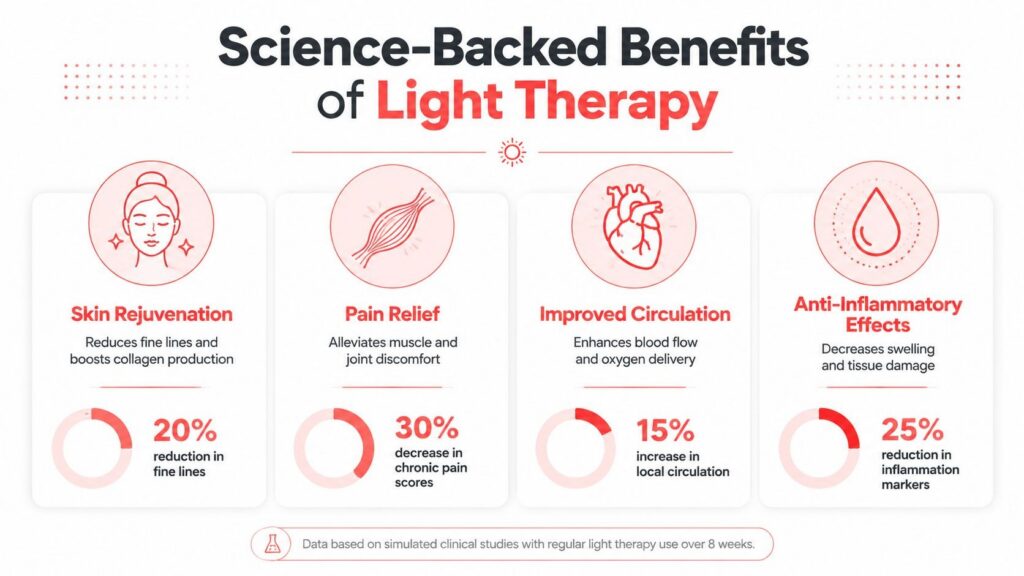
A dermatology review also reported a randomized controlled trial of 41 patients who received blue LED light at 414 nm and 17.6 J/cm² every other day for 8 weeks, resulting in a 52% reduction in lesion count compared with no treatment. That review also notes that LED therapy is used for conditions such as mild to moderate acne, psoriasis, wrinkles, wounds, rosacea, eczema, and hair loss, and is generally non-invasive, with side effects that are rare and usually mild.
What does that mean for women’s wellness?
For women navigating fertility, pregnancy, or postpartum recovery, the most relevant takeaway is restraint. The best-supported uses tend to involve skin quality, wound support, acne care, and hair-related concerns.
That can still be meaningful. A postpartum patient may care about tissue healing and hair changes. Someone in fertility treatment may want a gentle modality that supports overall recovery and doesn’t add more strain to an already intense schedule.
| Concern | How evidence is generally described |
| Skin appearance | Better supported |
| Hair regrowth | Better supported |
| Acne protocols | Supported in condition-specific settings |
| Broad reproductive claims | Still limited |
The therapy can be part of supportive care. It shouldn’t be framed as proof of a fertility outcome.
Integrating LED Therapy with Acupuncture and Fertility Care
The most useful way to think about this combination is that each method speaks a different language while aiming toward some of the same goals. Modern photobiomodulation talks about cellular energy, tissue signaling, and inflammation. Traditional Chinese Medicine talks about Qi, Blood, circulation, regulation, and restoring balance.
How modern photobiomodulation overlaps with TCM thinking
In TCM, fertility and pregnancy support often involve more than reproductive organs alone. Treatment may consider sleep, digestion, stress load, cycle quality, circulation, and recovery capacity. LED light therapy can fit beside that model because it’s also used with a broader tissue-support mindset.
A patient receiving acupuncture for cycle regulation or IVF support might also benefit from therapies chosen to promote calm, support local tissue recovery, or reduce strain on the system. That doesn’t make the therapies interchangeable. It means they can be layered carefully.
A useful overview of this systems-based philosophy appears in this discussion of acupuncture and fertility support.
In both frameworks, the body isn’t treated as a machine with a single isolated broken part. The goal is to support conditions that allow better function.
A careful view of fertility-specific claims
Caution is paramount here. Some online discussions make fertility claims about red or near-infrared light, especially around conception support, pelvic application, or IVF preparation. But the evidence base is still limited.
Is LED Light Therapy Safe During Pregnancy and Postpartum
Safety questions deserve a direct answer. In general medical guidance, LED therapy is usually described as non-invasive, with side effects that are rare and usually mild. Even so, pregnancy changes the conversation because caution matters more than convenience.
Pregnancy calls for extra caution
During pregnancy, any complementary therapy should be discussed with the patient’s licensed practitioner and prenatal medical team. A conservative approach is appropriate, especially when treatment would be near the abdomen or pelvis.
That’s because pregnancy care isn’t only about whether a therapy seems gentle. It’s also about whether there is enough condition-specific evidence to guide exactly how and where it should be used. With LED light therapy and reproductive outcomes, the evidence still isn’t clear enough to support broad, casual recommendations.
A careful pregnancy framework often includes:
- Provider review first: discuss use with both the acupuncture physician and OB-GYN
- Area selection matters: avoid self-directing treatment over the abdomen during pregnancy unless a medical team has specifically approved it.
- Use the smallest necessary plan: choose conservative, clearly justified applications rather than broad experimentation.
A related look at supportive prenatal care appears in this article on acupuncture for pregnancy discomfort.
Postpartum is a different conversation
Postpartum recovery often brings a different set of needs. Tissue healing, soreness, fatigue, and hair shedding may all come into play. In that setting, a non-invasive modality may be considered as part of a broader recovery plan, especially when a patient has medical clearance for the area to be treated.
Gentle doesn’t always mean appropriate during pregnancy, but it may become far more useful after delivery when recovery support is the focus.
For postpartum women, the key is still personalization. A recent vaginal birth, a C-section, breastfeeding demands, sleep deprivation, and hormonal shifts all affect what kind of support makes sense.
Your Session at Longevity Acupuncture Miami
You arrive carrying a lot in your mind. Maybe you are preparing for fertility treatment, recovering after birth, or trying to make careful choices while your body is changing. A session starts with that full picture, not with a device.
What a treatment visit feels like
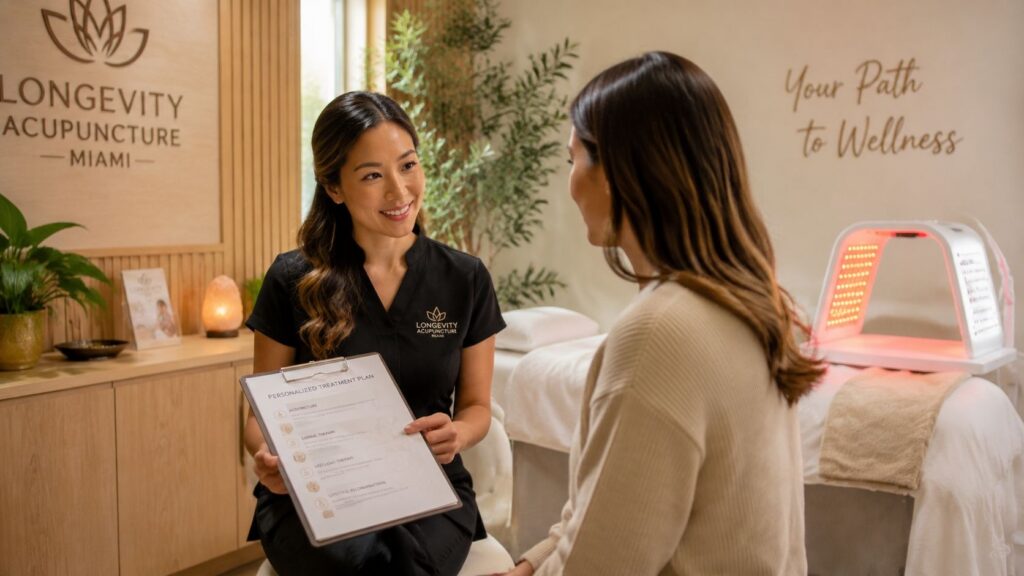
The first part of the visit is a conversation. We look at your symptoms, your health history, your goals, and where you are in the fertility, pregnancy, or postpartum process. That matters because light therapy is not used as a one-size-fits-all add-on. It is used with intention.
During treatment, you rest while the area is positioned for exposure to our professional-grade light therapy devices. The experience is usually quiet and low stimulation. When paired with acupuncture, many patients describe the session as providing a profound sense of calm. That combination makes sense. Acupuncture works through a Traditional Chinese Medicine lens to support balance, circulation, and the smooth movement of qi and blood. Photobiomodulation works at the cellular level, supporting energy production and helping calm inflammatory stress. They approach the same goal from different angles.
Patients who want a closer look at our light therapy services at Longevity Acupuncture can read more there.
Why professional dosing matters
A lamp that shines bright across the room is different from a treatment designed to deliver a useful amount of light to a specific area of tissue. The practical questions are simple, but they matter. How far is the device from the body? How long is the area exposed? How often should sessions be repeated? Which body region makes sense for your current stage of care?
This is one reason professional treatment can feel more reassuring than copying a generic online routine. Someone preparing for IVF may need a very different plan from someone supporting recovery after delivery. Someone with reactive skin may need a gentler setup than someone addressing a medically cleared scar or localized inflammation.
A helpful way to understand it is to compare light therapy to acupuncture point selection. The tool matters, but precision matters more. The right approach depends on the person in front of you, the tissue being treated, and the goal of care.
In practice, your session is built around questions like these:
- What is the treatment trying to support right now
- Which area can be treated appropriately
- How should the light be positioned for that area
- How often does it make sense to repeat treatment
- How does it fit with acupuncture and the rest of your care plan
That individualized planning is what makes LED light therapy more than a wellness trend. It becomes one part of a thoughtful, whole-body approach to women’s reproductive health.
Common Questions About LED Light Therapy
Does it hurt or feel hot?
LED light therapy is generally painless. Those undergoing treatment typically feel little to nothing, or describe it as gently warm and relaxing. It isn’t meant to feel harsh.
Is it the same as a tanning bed?
No. Tanning beds use ultraviolet light. LED therapy uses non-UV light and is designed for a different purpose entirely. That distinction is one of the first things patients should understand before deciding whether a treatment sounds appropriate for them.
Can an online device do the same thing?
Not always. Many people shop by wavelength alone, but that’s only one piece of the decision. Practical guidance on device comparison notes that consumers often focus on wavelength, while the more useful question is how much light reaches the target tissue. That depends on dose, distance, and beam angle, and there’s little evidence that one specific beam angle is superior overall.
That means a simple checklist can help:
- Look beyond the color label: red light alone doesn’t reveal the actual delivered dose.
- Consider treatment distance: output falls as the device moves farther away.
- Be cautious with fertility claims: many home-use claims go beyond the evidence.
- Value professional judgment: the right protocol matters as much as the device itself.
How long does it take to notice a change?
Results are usually cumulative. Some people notice subjective changes, such as comfort or skin feel, earlier, while visible changes may take repeated sessions. The timeline depends on the concern being addressed, the tissue involved, and whether the treatment plan is consistent.
The most realistic expectation is gradual change with repeated, properly dosed treatment, not an overnight transformation.
Someone using LED light therapy for supportive wellness during fertility care should think in terms of consistency and integration, not quick fixes. That’s the most balanced way to approach LED light therapy.
Those exploring fertility support, IVF or IUI care, pregnancy discomfort relief, or postpartum recovery in South Florida can schedule a consultation with Longevity Acupuncture to learn whether a personalized, evidence-aware plan may include acupuncture and LED light therapy.