

Miscarriage prevention usually becomes urgent in a very human moment. A positive pregnancy test is sitting on the bathroom counter. A scan is scheduled, but it feels far away. Or there’s already been a loss, and the next pregnancy carries hope and fear at the same time.
That fear deserves honesty, not false reassurance. No clinician can promise that a miscarriage won’t happen. What care can do is reduce avoidable risk, identify treatable causes, and support the body as early as possible. That’s a different promise, but it’s a real one.
For many patients, the hardest part is not knowing what matters. Generic advice often blurs together. Eat well. Rest. Try not to stress. Those suggestions aren’t wrong, but they don’t answer the question many are truly asking: what can be checked, what can be treated, and what, sadly, is outside anyone’s control?
This article takes that question seriously. It looks at miscarriage prevention through a layered lens. Medical evaluation comes first. Personalized treatment follows the cause when a cause can be found. Whole-body support, including acupuncture, may help patients feel steadier and better supported before conception and in early pregnancy.
A Compassionate Approach to Miscarriage Prevention
A patient may look calm in the treatment room and still feel panicked underneath. That’s common after one loss, and it’s even more common after repeated losses. Many people arrive carrying a private list of worries. Was it stress? Was it something they ate? Should they have started supplements earlier? Did they miss a warning sign?
Most of the time, that self-blame is misplaced.
Miscarriage is common on a population level. Major public-health sources estimate that about 10 to 20% of known pregnancies end in miscarriage, and the risk is concentrated early, with roughly 80% of losses occurring in the first 12 weeks, according to Tommy’s miscarriage statistics overview. Those numbers matter because they remind patients that early loss is sadly a common medical event, not proof that the body has failed.
The most useful frame for miscarriage prevention is risk reduction, not guaranteed control.
That shift changes the conversation. Instead of chasing miracle fixes, care becomes more grounded. A clinician looks for patterns in menstrual cycles, hormone symptoms, thyroid history, autoimmune concerns, blood sugar issues, uterine factors, and prior pregnancy history. The patient’s job is not to solve everything alone. The patient’s job is to get good support and clear next steps.
A compassionate approach also respects how different patients process uncertainty. Some want immediate testing. Others need time to recover emotionally before discussing another pregnancy. Some are trying to conceive naturally. Others are preparing for IUI or IVF. Good care adapts to those realities.
What is and isn’t usually preventable
Some losses happen because of factors that can’t be changed. Others occur in settings that can be identified and treated. Both truths can exist at once. That’s why miscarriage prevention should never be presented as a simple checklist.
What helps most is a layered plan:
- Medical evaluation first to identify causes that may need direct treatment
- Lifestyle support to strengthen the overall pregnancy environment
- Complementary care to support stress regulation, circulation, and whole-body balance
- Close monitoring in early pregnancy, when reassurance and early intervention may matter most
Understanding the Causes of Pregnancy Loss
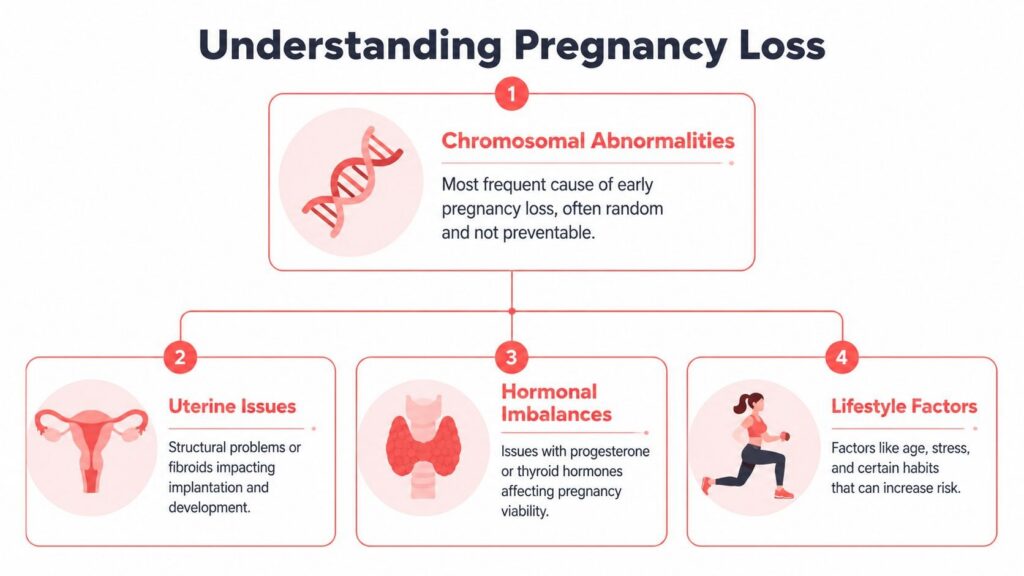
Early pregnancy loss often feels mysterious, but the broad categories are known. The most common cause of miscarriage in early pregnancy is chromosomal abnormality. In plain terms, the embryo may not be developing normally from the start. When that happens, nothing the patient did caused it, and nothing simple would have prevented it.
That point matters because guilt often attaches to the wrong things. A stressful week, a workout, travel, or one imperfect meal usually isn’t the explanation patients fear it is.
What is and isn’t usually preventable
A large gap in online advice is that it often treats every miscarriage as equally preventable. That isn’t accurate. Tommy’s summarizes a large review showing that only a minority of miscarriages are preventable by modifying several risk factors, with one cited study estimating 25.2% were preventable when multiple risks were moved to low-risk levels. At the same time, many cases still aren’t preventable because chromosomal abnormalities are the leading cause. That discussion appears in Tommy’s guide to reducing the risk of miscarriage.
That doesn’t make prevention efforts pointless. It makes them more precise.
| Cause type | What it means for care |
| Largely non-modifiable | Chromosomal problems are often random and may not reflect anything the patient could have changed |
| Potentially modifiable or treatable | Hormonal issues, thyroid dysfunction, blood sugar problems, uterine structural concerns, clotting or autoimmune issues, and certain health habits may justify closer evaluation |
Patterns worth discussing with a doctor
When pregnancy loss recurs, the threshold for deeper evaluation decreases. The exact workup depends on the person, but certain patterns tend to matter more:
- Repeated early losses can raise questions about progesterone support, thyroid function, metabolic issues, or uterine factors.
- Known endocrine conditions, such as thyroid disorders or insulin resistance, may require closer management before conception and in early pregnancy.
- Structural concerns, such as uterine cavity abnormalities or fibroids, may change implantation conditions for some patients.
- Autoimmune or clotting concerns may warrant specialist input when the history suggests them.
The key question isn’t “How do patients prevent every miscarriage?” It’s “Which risks in this specific history are actionable?”
That distinction protects patients from two extremes. One is false guilt. The other is false certainty. Both make a hard experience harder.
Evidence-Based Medical Care for Reducing Risk
For recurrent pregnancy loss, broad advice is not enough. Medical care works best when treatment follows the most likely cause. Expert review notes that etiology-specific treatment matters more than a one-size-fits-all approach, with options such as levothyroxine, metformin, anticoagulants, micronutrient progesterone, and micronutrient supplementation used according to the underlying risk profile.

Why targeted treatment matters
A patient with thyroid dysfunction does not need the same plan as a patient with insulin resistance. A patient with suspected clotting risk does not need the same plan as someone with luteal-phase concerns. That sounds obvious, but it’s exactly where oversimplified miscarriage prevention advice often fails.
Medical evaluation may include review of cycle history, prior ultrasound findings, pregnancy timing, lab work, and a careful history of previous losses. In some cases, a reproductive endocrinologist or OB-GYN may recommend further testing for uterine issues, endocrine concerns, or immune and clotting-related factors.
That’s also why treatments that are heavily promoted online can disappoint in practice. Some interventions may help a specific subgroup and do little for others. For example, the same expert review notes that immunotherapy doesn’t have sufficient evidence to recommend because available trials did not reduce miscarriage or increase live birth.
Where progesterone may fit
Progesterone support is one of the most discussed interventions, and the nuance matters. It is not a blanket answer for every pregnancy. But for women with recurrent miscarriage, the evidence is more encouraging.
A meta-analysis of 10 trials including 1,684 women found that first-trimester progestogen supplementation reduced miscarriage rates from 27.5% to 20.1% compared with placebo or control, with an average risk ratio of 0.73 according to the Cochrane-linked review of progestogen for preventing miscarriage. That supports progesterone as a reasonable option for selected high-risk patients, especially those with prior losses rather than unselected pregnancies.
For patients already navigating repeated loss, this is usually where coordinated care matters most. Acupuncture should sit beside medical care, not in place of it. Patients seeking an integrative overview may also find it helpful to read about support for recurrent miscarriage within the context of a broader care plan.
Good prevention work is selective. It asks who is likely to benefit from which intervention, and who probably won’t.
Empowering Lifestyle and Diet Choices for a Healthy Pregnancy
Lifestyle advice can sound shallow when it’s delivered as a generic command to “just be healthy.” It becomes more useful when it’s framed correctly. These choices don’t guarantee an outcome. They help create a steadier baseline for conception and early pregnancy.
That distinction protects patients from blame while still giving them something constructive to do.
The value of a steady baseline
The same Tommy’s review discussed earlier highlights that some miscarriage risk is linked to modifiable factors, even though many losses remain unrelated to anything a patient could have changed. That’s why preconception care matters. It gives the body a better starting point.
In practice, the strongest lifestyle plan is usually simple and consistent:
- Prenatal nutrition should be established before conception, not after a positive test if possible.
- Blood sugar stability matters for patients with insulin resistance, PCOS, or metabolic concerns.
- Sleep and nervous system regulation support hormone rhythms and recovery.
- Avoiding alcohol, smoking, and recreational drugs removes obvious avoidable strain during the conception window and pregnancy.
- Moderate movement supports circulation, stress regulation, and overall health.
Some patients also benefit from reviewing everyday eating habits rather than chasing restrictive diets. A more balanced plate, regular meals, adequate protein, and fewer blood sugar swings are often more helpful than perfectionism. For a Traditional Chinese Medicine perspective on food patterns, some patients explore guidance such as Five Element food principles as part of a broader wellness conversation.
Lifestyle support without self-blame
The emotional trap is easy to see. If behavior matters at all, patients may assume every loss must be traceable to a personal mistake. That isn’t what the evidence says.
A healthier way to use lifestyle medicine is to focus on support rather than control.
- Choose what’s sustainable. A plan that can be followed calmly is more useful than a perfect plan that increases anxiety.
- Treat chronic issues early. Thyroid concerns, insulin resistance, and inflammatory patterns deserve attention before pregnancy when possible.
- Reduce obvious exposures. Patients don’t need to live in fear of everything around them, but a practical reduction of known harmful substances is reasonable.
- Use stress support wisely. No one miscarries because they had a hard day. Still, chronic overwhelm can make treatment adherence, sleep, appetite, and self-care harder.
Lifestyle changes are most powerful when they support the body without turning pregnancy into a test the patient must pass.
This is especially relevant in Miami, South Miami, Coral Gables, Pinecrest, Coconut Grove, and across South Florida, where many patients are balancing fertility care with demanding work schedules, long commutes, and heat-related fatigue. The plan has to fit real life, or it won’t last.
How Acupuncture May Support Your Body Before and During Pregnancy
Acupuncture enters this conversation best when it stays in its proper role. It is complementary care. It doesn’t replace obstetric care, fertility care, lab evaluation, or indicated medication. What it may do is support the terrain in which conception and early pregnancy are unfolding.
That’s especially relevant because the evidence base for many miscarriage prevention strategies is still evolving, and stakeholders don’t always agree on what counts as a meaningful treatment effect, as discussed in this 2024 survey on miscarriage-prevention trial outcomes. In practice, that makes individualized care more important, not less.
A Traditional Chinese Medicine view
In Traditional Chinese Medicine, recurrent loss is not treated as a single diagnosis. Patterns may involve weakness, deficiency, stagnation, or imbalance. The language differs from conventional medicine, but the clinical aim is familiar. Improve regulation. Support circulation. Reduce stress reactivity. Strengthen the system before and during early pregnancy.
Acupuncture care is often used to support:
- Nervous system regulation, especially when fear and hypervigilance are high after prior loss
- Cycle quality before conception, including efforts to support a healthier baseline
- Whole-body balance during early pregnancy, alongside physician-directed care
- Physical symptoms such as nausea, fatigue, and tension may make early pregnancy harder to tolerate
This is also where timing matters. In fertility-focused acupuncture, a preconception window of about three months is often practical because it gives enough time to work on cycle regularity, stress patterns, sleep, digestion, and overall resilience before pregnancy begins. If conception has already happened, support can still be customized for the early weeks.
Why timing matters
Patients often seek acupuncture only after a positive test and rising anxiety. That can still be helpful, but earlier support usually allows a more thoughtful plan. The body is less reactive. The patient has more room to make changes gradually. Medical findings can be integrated more clearly.
For some, that plan may include a fertility-focused acupuncture schedule, nutrition support, supplement review with the prescribing clinician, and coordination with the fertility clinic or OB-GYN. Patients interested in how acupuncture is used during pregnancy may also want to review the reasons people seek acupuncture during pregnancy when considering supportive care.
One option in Miami is Longevity Acupuncture, where care may include acupuncture, Chinese herbal guidance (when appropriate), and lifestyle support within a reproductive health framework. That kind of setting is most useful when it remains coordinated with the patient’s medical team and suited to the specific history.
Your Personalized Care Plan at Longevity Acupuncture
Patients who seek support around miscarriage prevention usually don’t need more generic advice. They need a plan that reflects their own history. That starts with listening carefully.
What happens in the first visit
A thorough intake should look beyond the most recent pregnancy. The clinician reviews menstrual patterns, prior losses, fertility treatment history, known diagnoses, sleep, digestion, stress load, and any relevant lab or imaging findings the patient already has. In Traditional Chinese Medicine, those details help shape the pattern diagnosis. In practical terms, they help avoid cookie-cutter care.
A personalized plan may include:
- Acupuncture treatment aimed at supporting regulation and overall reproductive wellness
- Diet and lifestyle guidance matched to the patient’s constitution, symptoms, and daily routine
- Discussion of supplements or herbs only within a safety-conscious framework, especially when pregnancy is possible or confirmed
- Timing recommendations for preconception support, IVF support, or first-trimester care
How care is coordinated
Integrated care matters most for patients with prior losses, IVF pregnancies, thyroid conditions, or other known medical concerns. Acupuncture works best as part of a team model. That means staying aligned with the recommendations coming from the OB-GYN, reproductive endocrinologist, or maternal-fetal medicine specialist when one is involved.
Dr. Vivian Shou-Litman is a Florida-licensed acupuncture physician and NCCAOM Diplomate of Oriental Medicine, and care at a reproductive-health practice like this is typically organized around both symptom relief and root-cause support. For patients in Miami and nearby communities, this may make the process feel less fragmented. The medical doctor manages diagnosis and primary treatment. The acupuncture plan supports the patient’s overall stability through that process.
The best care plan is specific enough to feel personal and flexible enough to change as new information comes in.
Common Questions About Pregnancy Loss and Support
Can miscarriage always be prevented?
No. Some miscarriages happen because of factors that can’t be changed, especially chromosomal problems in early development. Miscarriage prevention is best understood as lowering avoidable risk and identifying treatable causes early.
When should someone seek evaluation after a loss?
That depends on the clinical picture, but earlier evaluation makes sense when there have been repeated losses, known hormone or thyroid issues, IVF treatment, abnormal bleeding, or a prior recommendation for closer monitoring. A treating physician can decide what testing is appropriate.
Can acupuncture replace medical care?
No. Acupuncture is complementary. It may support stress regulation, symptom relief, and whole-body balance, but it shouldn’t replace obstetric or fertility care, especially when recurrent loss or other medical concerns are present.
When should acupuncture start?
Earlier is usually better. Many fertility-focused plans begin before conception, so there’s time to support cycle health, sleep, stress regulation, and overall baseline wellness. If pregnancy has already started, care can still be adjusted for the first trimester.
Is there still hope after recurrent loss?
Yes. Recurrent loss is heartbreaking, but it is not the same as having no options. Many patients benefit from a more focused workup, a more personalized treatment plan, and steadier support during the next attempt at conception or early pregnancy. What helps most is avoiding guesswork and building a plan around the actual history.
If miscarriage prevention is part of the current conversation, Longevity Acupuncture offers fertility- and pregnancy-focused acupuncture in Miami, with care that can be coordinated alongside an OB-GYN or fertility specialist. That kind of individualized support is often the most grounded next step in miscarriage prevention.